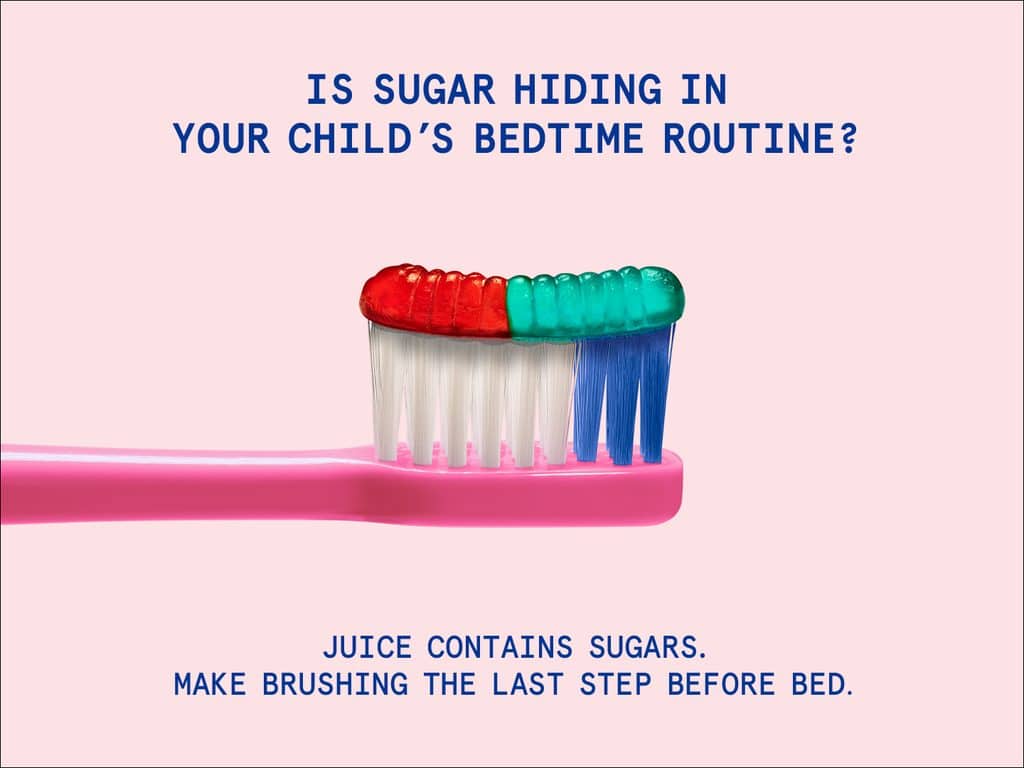
Establishing a predictable child’s bedtime routine is a cornerstone of early childhood parenting. From warm baths and soft pyjamas to storytime and cozy lullabies, these evening rituals help calm a child and prepare their mind and body for sleep. However, even the most loving and well-planned bedtime routine can harbour a hidden risk to a child’s long-term health. The British Columbia Dental Association (BCDA) encourages parents and caregivers to make tooth-brushing the final step in a child’s bedtime routine. How the evening ends can make an important difference to a child’s oral health, and the message is simple: after the last feed, drink or snack, brush before bed!
The Hidden Risk: Sugar Before Sleep and Your Child’s Bedtime Routine
Many parents are surprised to learn that comforting bedtime habits such as offering a cup of warm milk, formula, juice, or a snack before sleeping, can contribute directly to childhood cavities.
It can be easy to understand why sugary fruit juices can contribute to tooth decay when part of your child’s bedtime routine, but milk and formula contain natural sugars as well. When a baby or toddler drinks milk or formula and is put straight to bed, natural sugars can remain on the teeth if they aren’t brushed away before bed.
During sleep, less saliva is produced than while awake. Saliva helps protect teeth by washing away food particles and helping to neutralize acids in the mouth. If sugars from milk, formula, juice, or other foods and drinks remain on a child’s teeth overnight, bacteria in the mouth can use those sugars to produce acids that contribute to tooth decay. Over time, repeated exposure can increase the risk of Early Childhood Caries (ECC), the term used for tooth decay in young children.
Baby Teeth Matter More Than You Think
A common misconception is that primary (baby) teeth matter less because they eventually fall out. In reality, baby teeth play an important role in a child’ s overall health and development:
Eating and Nutrition: Healthy baby teeth help children eat comfortably, and support proper nutrition for growth.
Speech Development: Baby teeth help children learn to speak clearly.
Making Space for Adult Teeth: Primary teeth hold space for permanent teeth and help guide them into position. If a baby tooth is lost too early, neighboring teeth can move into the space and interfere with the permanent tooth coming in properly.
Untreated tooth decay can progress deeper into a baby tooth, causing pain and infection, and sometimes leading to the tooth being removed. Preventing decay through early can help reduce the need for extensive treatment.
Step-by-Step Oral Hygiene by Developmental Stage
Oral care should begin even before a child’s first tooth appears, and your child’s bedtime routine should evolve as they grow. Here are some age – and development-appropriate ways to help care for children’s teeth:
Before Teeth Appear (Infants): Twice a day, and specifically after the final evening feed, use a clean, soft, damp cloth or sterile gauze to gently wipe your infant’s gums. This wipes away leftover milk residue and gets your baby comfortable with daily oral care routines, making the future transition to a toothbrush much easier.
After the First Tooth Appears (Babies & Toddlers): Begin brushing as soon as the first tooth appears, using a small, soft-bristled infant toothbrush and a rice-grain sized amount of fluoride toothpaste. Brush twice a day, lifting your child’s lip to brush along the gum line and all sides of the teeth.
Growing Toddlers & Young Children (Ages 3+): As children grow and gain dexterity, they can begin brushing with support from a parent or caregiver to make sure all tooth surfaces are cleaned. Once a child can reliably spit out toothpaste rather than swallow it, use a pea-sized amount of fluoride toothpaste. Many children still need assistance and supervision with brushing until approximately age 8 to 10, depending on their ability.
Best Practices for Good Lifelong Oral Health
Beyond setting bedtime brushing boundaries, parents can build strong habits through several additional daily practices:
● Avoid Placing Bottles in Bed: Do not put a child to bed with a bottle. After brushing, offer only plain water.
● Avoid Sharing Items that can Transfer Bacteria: Cavity-causing bacteria can be passed from caregiver to child. Avoid sharing toothbrushes, utensils, testing food temperature with your own mouth, or cleaning pacifiers with your saliva.
● Schedule the First Dental Visit Early: Bring your child to a dentist within six months of their first tooth appearing, or by their first birthday. Early dental visits support oral health and help create positive experiences at the dentist from an early age.
● Check the Gum Line: Lift your child’s top lip regularly and look closely along the gum line. If you see faint white or brown spots, or notice anything unusual, contact your dentist rather than waiting until the next scheduled visit.
A Small Change with Big Rewards
Rethinking a child’s bedtime routine does not require a complete overhaul, just a simple reordering of steps. By making feeding or drinks happen before brushing, and ensuring that brushing with fluoride toothpaste is the final step before sleep, you can help clean away sugars left on the teeth and reduce the risk of tooth decay. This simple change can help protect a child’s teeth, support healthy development, and build a strong foundation for a lifetime of confident, healthy smiles.
Breast Cancer Awareness Month: A reminder to know your body, prioritise your health, and seek medical attention early. Every October, pink ribbons appear on social media, in workplaces, hospitals, and public spaces as the world marks Breast Cancer Awareness Month. We share messages of hope, celebrate survivors, honour those we have lost, and encourage one…
Like many parents, I am all too familiar with the back-to-school question that rollsaround every September: what do I put in my child’s lunchbox? Something my kid willeat. Something that survives the bus ride and the bottom of a backpack. Somethingsafe and healthy. But working in Canada’s food system has made me think about something…