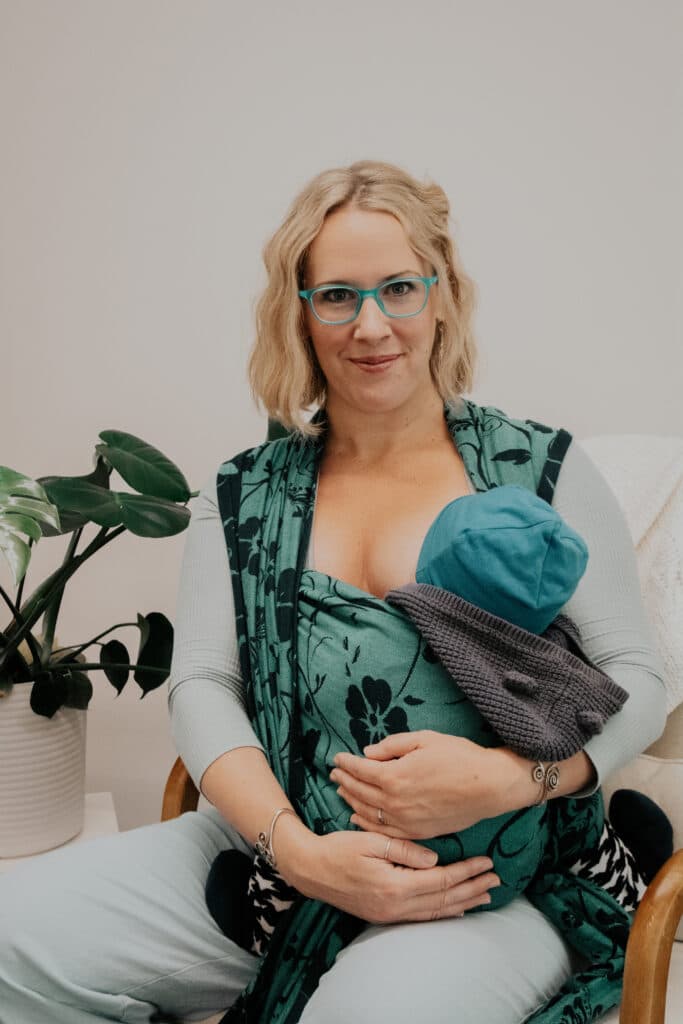
I was standing in my kitchen with Baby Z on my hip when I felt it.
Warm and immediate. The consistency was unmistakable.
Liquidy poop, dripping down my leg.
It was another unsuccessful attempt at elimination communication, the practice of trying to respond to a baby’s cues to avoid diapers altogether. I had started experimenting with it partly out of curiosity, and partly because I couldn’t stop thinking about the scale of the diaper industry, a multibillion-dollar system built to manage the literal mess of infancy.
That moment, standing there, holding my baby, laughing and slightly horrified, made something very clear.
Infancy is messy. It always has been.
But instead of designing systems that support babies and parents in navigating that reality, we’ve built an entire industry around controlling it, packaging it, and selling it back to us as a problem to solve.
How the Baby Industry Profits From Normal Parenting Challenges
Babies have not suddenly become more complicated. So why is parenthood suddenly dependent on these “solutions” for infants to thrive?
The modern baby industry has mastered a simple trick: turn normal infant behavior into a consumer problem. Night waking becomes a sleep issue. Frequent feeding becomes a logistics issue. Wanting to be held becomes a dependency issue. Then the market arrives with the fix: the bassinet, the monitor, the app, the bottle system, the developmental toy set, the tracking dashboard.
From a developmental science and human origins perspective, many of the behaviors parents are taught to worry about are not signs that something is wrong. Human babies are born unusually immature and dependent. Across most of human history, infant survival depended on close contact, frequent feeding, and sleeping near caregivers. Evolutionary and anthropological work on infant sleep argues that night waking and proximity-seeking are the biological norm, not evidence that a baby or parent is malfunctioning.
The same is true for feeding. Pediatric professionals recommend nursing in response to cues, at least 8 to 12 times per day in early infancy. And this is the Western baseline. In small-scale and hunter-gatherer communities, breastfeeding happens multiple times per hour. Frequent feeding is what young human infants do.
Repackaging Infant Behavior as a Problem to Solve
But that is exactly what makes the baby business so effective.
It sells a reinterpretation of infancy:
A baby who wakes often can be diagnosed as needing a better sleep product. A baby who feeds often can indicate needing a human milk substitute to keep them fuller longer. A baby who wants to stare at one object for a long time can be reframed as needing more stimulation, more enrichment, more gear.
Do Babies Really Need More Stuff?
Infants do not benefit from more stuff. Research has found that mothers and infants establish higher-quality shared attention with fewer toys, and that toddlers play in more varied and deeper ways when they have only four toys instead of sixteen. More products do not automatically create better development. Sometimes they create more distraction.
The Hidden Cost of Constant Tracking and Notifications
The same logic applies to parents.
The market frames more data as more control, and more control as better caregiving. But more data does not always bring more peace. One study found that parents received an average of 293 mobile notifications per day and picked up their phones 93 times; when notifications prompted more pickups, parenting stress was higher.
More tracking does not always reduce anxiety.
Sometimes it feeds it.
How Marketing Fuels Parental Anxiety
This is where the manipulative genius of the industry comes into view. It does not only respond to parental anxiety, it helps produce it. Market research on baby products openly identifies social media and influencer marketing as drivers of consumer perceptions and purchasing behavior.
That matters because exhausted new parents are not making choices in a neutral environment. They are making them inside an algorithmic marketplace that rewards fear, optimization, and the fantasy that the right purchase can eliminate uncertainty.
Formula Marketing and the Power of Social Media
Infant feeding offers one of the clearest examples. The World Health Organization reported that formula-related social media content reached 2.47 billion people in six months and generated more than 12 million engagements. Formula companies were posting around 90 times per day and reaching about three times the audience of breastfeeding information from non-commercial accounts.
That kind of reach does not just sell products.
It reshapes what families believe is normal, necessary, and urgent.
The Emotional Weight of the Postpartum Period
This is not about parenting choices or breastfeeding versus formula. This is about how massive marketing budgets create messages that mothers absorb during one of the most psychologically vulnerable times in adult life.
The postpartum period is already associated with heightened anxiety, hypervigilance, identity shifts, sleep deprivation, and enormous pressure to “get it right.” Instead of responding to that reality with stronger systems of support, modern parenting culture often responds with more products.
The underlying message is subtle but powerful: if you are anxious, you are underprepared. And if you are underprepared, there is probably another product that can fix it.
Mothers Need Support, Not More Products
But maternal anxiety is not a market opportunity.
It is a public health issue.
And many mothers do not need another developmental toy subscription, another smart device, or another perfectly branded organizing system. They need someone to hold the baby while they shower. Someone to bring food. Someone to reassure them that frequent waking is normal. Someone to tell them that babies are not machines to optimize.
Parenting Was Never Meant To Be Done Alone
Human beings evolved to raise children in communities, not in isolated households supported primarily by consumer goods.
What many mothers are experiencing is not personal failure. It is the collision between biologically normal infant behavior and a culture that has replaced collective caregiving with individualized consumption.
Babies do not need to sleep through the night to be normal. They do not need to stretch feedings unnaturally to be efficient. They do not need a mountain of toys to learn. And parents do not necessarily need more dashboards, more notifications, and more metrics to care better.
Rethinking What Families Truly Need
What families need is clearer evidence-based guidance, stronger safety standards, less manipulative marketing, more durable and reusable product design, and more honest public messaging about what infant development actually looks like.
But they also need something much less marketable:
The kinds of things that actually reduce parental stress rarely arrive in branded packaging.
Babies Are Not Broken — They Are Human
Above all, families need a culture willing to admit that many babies are not broken. They are just human.
And mothers were never supposed to navigate early parenthood alone with an algorithm, a shopping cart, and a tracking app.
If we continue treating normal infancy as a market opportunity, families will keep paying twice: once at checkout, and again in waste, anxiety, and the slow erosion of trust in their own instincts.
Mothers do not need more “things” to optimize infancy.
They need more people willing to help carry it.
About the Author
Emily Little, PhD, is a consultant, speaker, and science communicator translating science into real-world solutions for infants and caregivers. As a researcher trained in experimental psychology and human origins from University of California San Diego, she has studied childrearing around the world and published in top peer-reviewed journals including Pediatrics and Child Development. Emily is committed to making science more inclusive and accessible to all and she shares daily research breakdowns on The Baby Myth Buster platform on LinkedIn, as well as with global outlets like HuffPost and The Los Angeles Times. She lives in Vancouver, BC where she spends her time at the beach and riding bikes with her toddler, partner, and dog.
From infancy and toddlerhood to pre-kindergarten, these formative years bring extraordinary growth as our children discover who they are. But this is just the beginning of their development. Today, we are taking a close look at Rothewood Academy's holistic approach to early education and what this could mean for your child. From learning to communicate…
Let's talk on co-parenting, the worry usually starts small. Your son shrugs at the tablet and says he will talk to his dad another time. A call gets missed, then another. Nobody has done anything wrong, and yet the relationship feels thinner than it did six months ago. Distance rarely changes how much a parent…