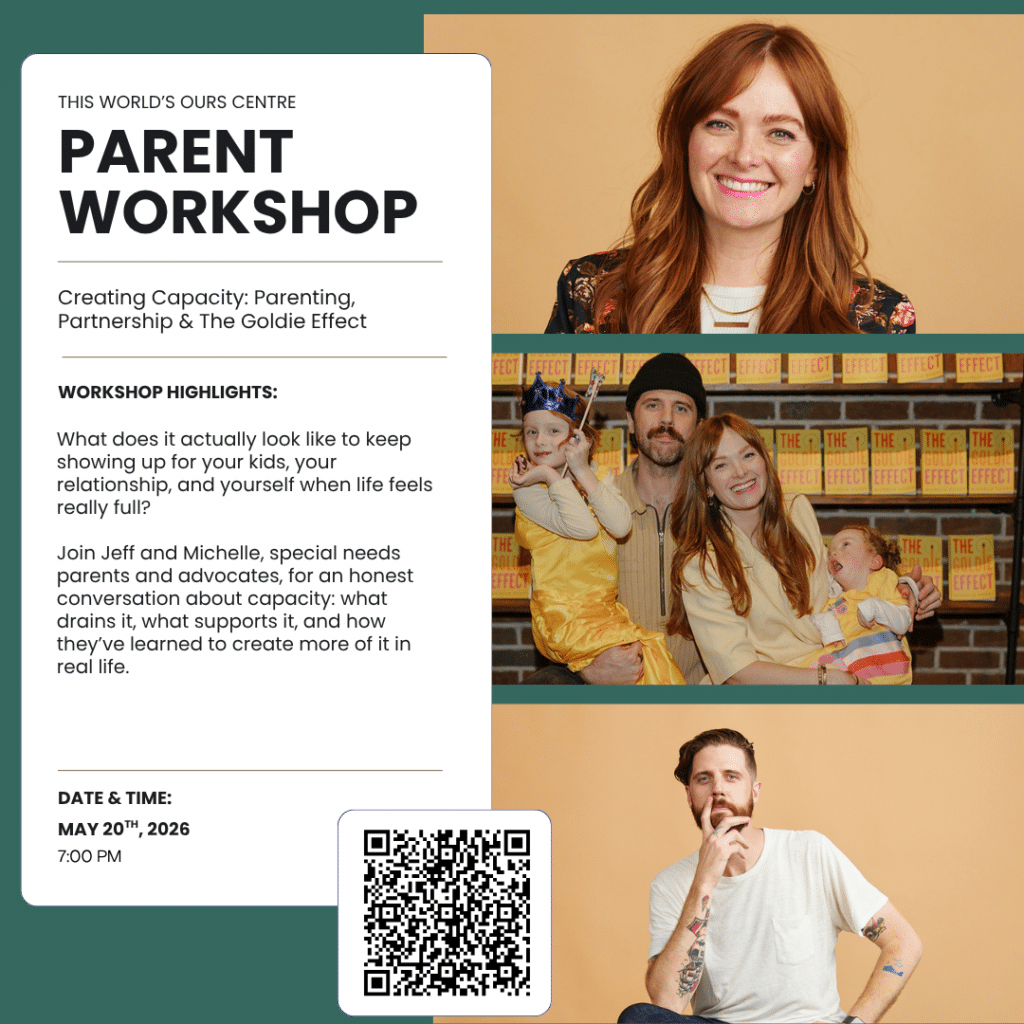
Join the conversation and feel the community Wednesday May 20 at This Worlds Ours Centre.
Scroll through social media for five minutes and it’s all you see: tidy kitchens, well-dressed kids, elaborate weekend activities led by parents who are calm, organised and personally fulfilled. This highlight reel creates the illusion that everyone else has parenting figured out. That others have more patience, more systems, more capacity and that things are easier for them. But I find, if you fall into a real conversation with almost any parent, a different story comes out. Parenting is hard. We’re all in it.
It’s not just that it’s a “busy week,” we’re in it in a layered, ongoing, identity-shifting way that asks more than you feel you have to give. For many parents, especially those raising neurodiverse or medically complex children, the concept of “capacity” isn’t just a buzzword. It’s the difference between coping and collapsing.
Capacity Isn’t Productivity
Parenting capacity isn’t about how much you can get done in a day. It’s about how much you can hold. It’s the ability to regulate your emotions while your child is dysregulated. To navigate appointments, school emails, meals, work, relationships, and your own needs, often simultaneously. It’s your mental load, your emotional bandwidth, your nervous system’s resilience. Capacity fluctuates depending on the day.
Some days you feel steady and capable. Other days, even small tasks feel overwhelming as stress compounds. The problem isn’t that your capacity changes, it’s that we live in a culture that expects it to stay consistently high.
Under Pressure
There’s an unspoken pressure in parenting to appear like you’re managing and in addition, enjoying the process in public and online. The village we all long to be part of, can be performative when everyone is struggling to keep their heads above water, kicking like mad below the surface.
We show up to school drop-off, sports, work meetings, playdates, smiling, chatting, keeping things moving. Meanwhile, navigating sleepless nights, health concerns, behavioural challenges, relationship strain, or your own mental load that no one sees. This disconnect can be isolating. It makes it feel like you’re the only one struggling to keep it all together.
That’s not the reality. Many parents are operating at or near capacity most days. They’re just doing it quietly.
Transforming Matrescence
Part of why parenting feels so disorienting is because it fundamentally changes you. Not just your schedule or priorities, but your identity.
This transformation is known as matrescence, a term gaining more attention thanks to experts like Cayley Benjamin. It describes the profound shift a woman experiences as she becomes a mother, physically, psychologically, socially, and emotionally. Much like adolescence, matrescence is a developmental phase. But unlike adolescence, it’s rarely acknowledged or supported in a structured way.
The struggle is often misinterpreted. We think something is wrong, instead of understanding that we are in the middle of a massive and ongoing transformation.
The Parenting Rewrite
For some parents, capacity is stretched even further by circumstances they never anticipated.
For author Michelle Hooey, everything changed the day her second daughter Goldie was born. Michelle and her husband Jeff began a journey through medical complexity, uncertainty, advocacy, and a complete reimagining of what life would look like.
Michelle’s book, The Goldie Effect: How to Rewrite Your Life Without Burning It Down is both deeply personal and widely relatable. It speaks to the reality that parenting doesn’t always follow the script we expect and that resilience and capacity aren’t about pushing harder, but about learning how to rebuild in small, sustainable ways.
“Conversations around capacity matter because the weight of carrying everything alone eventually becomes too much,” says Michelle. “When we don’t communicate that we’re drowning, that we need support, or that we need rest, resentment builds and burnout becomes a real risk. I’ve lived that. Honest conversations about capacity help protect not only your own well-being, but the health of your relationship and your family.”
One of the frameworks she shares, the 15-Minute Rewrite, offers a grounded approach to finding clarity and regulation without requiring a full life overhaul. It’s a reminder that capacity isn’t built through perfection. It’s built through small, consistent moments of presence.
You’re Not the Only One
There’s real value in being around parents having honest conversations. Vulnerable, sometimes messy sharing that asks for help, advice or understanding. This is the kind of community we find at This Worlds Ours Centre in Vancouver, an inclusive centre providing a safe, social space, programs and workshops for neurodiverse children and families.
This kind of community is essential. It not only offers resources and a safe place to share real struggles, it reminds us that a lot of people are carrying more than you can see. Community doesn’t fix everything, but it does make parenting feel a little less isolating and often that’s exactly what you need.
Taking place on May 20, the evening brings together Cayley Benjamin, Michelle Hooey, and Jeff Norgren for a candid discussion on parenting, partnership, and what it really means to build capacity while raising children, especially those with diverse needs and special rights.
“My biggest hope for this evening is that every parent in the room feels genuinely seen, not just acknowledged, but truly understood by people who get it, because they’re living it too,” shares Cayley. “There’s something powerful that happens when you don’t have to explain yourself. And alongside that feeling, I want everyone to walk away with real, practical tools and micro-moments they can bring into their real lives, tomorrow, in the middle of all of it. Because that’s what real support looks like: being seen and feeling equipped.”
This conversation is not about leaving with all the answers. It’s about leaving feeling a little less alone, a little more understood, and with a few resources for the road ahead. Capacity isn’t about doing more, it’s knowing others and right there with you and about being supported enough that you don’t have to carry it all on your own.
Creating Capacity: Parenting, Partnership & The Goldie Effect
📅 Wednesday, May 20 ⏰ 6:30–9:00 PM (panel runs 7:00–8:15 PM) 📍 This World’s Ours Centre, 191 E 10th Ave, Vancouver 🎟️ Tickets are available here.
From infancy and toddlerhood to pre-kindergarten, these formative years bring extraordinary growth as our children discover who they are. But this is just the beginning of their development. Today, we are taking a close look at Rothewood Academy's holistic approach to early education and what this could mean for your child. From learning to communicate…
Let's talk on co-parenting, the worry usually starts small. Your son shrugs at the tablet and says he will talk to his dad another time. A call gets missed, then another. Nobody has done anything wrong, and yet the relationship feels thinner than it did six months ago. Distance rarely changes how much a parent…